At 6,000 m below the surface, seawater pressure reaches about 600 times the pressure at sea level. Underwater robots let researchers inspect that environment without sending people into it, using cables, batteries, sonar, cameras, and robot arms.
- ROVs send power and video through a surface tether.
- AUVs travel without a cable and record data for later review.
- Pressure, darkness, cold, and weak radio signals shape every design choice.
Two robot types, two ways to work
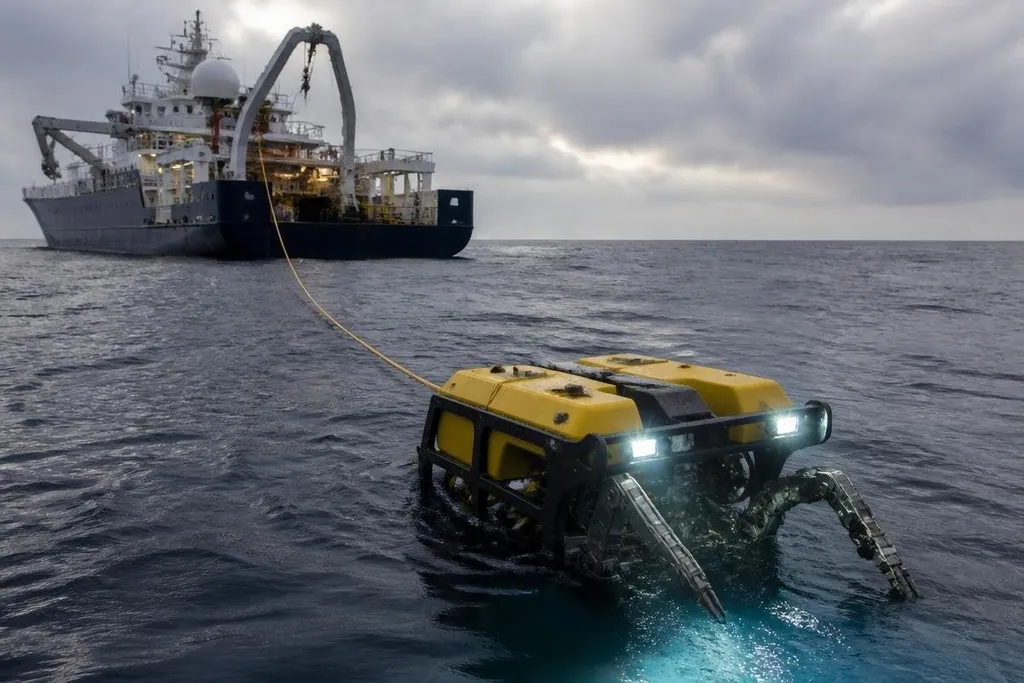
A remotely operated vehicle, or ROV, stays connected to a ship through a tether. The tether carries electrical power and sends control commands down to the vehicle, while video and sensor data travel back to the surface.
That link gives the crew a live view. An operator can move the ROV toward a rock, guide a manipulator arm, or stop when the vehicle reaches a fragile sample. The ship must stay near the work area, and the tether can snag on rocks, cables, or the seafloor.
An autonomous underwater vehicle, or AUV, carries its own battery and follows a planned route. It can map the seafloor, measure water conditions, or take photographs without a surface cable, but it cannot send a normal radio signal through seawater over long distances.
The AUV stores its data while it works. When its mission ends, it must return to a planned meeting point or rise to the surface, where the data can be recovered.
How a robot sees in the dark
Sunlight fades quickly underwater, so cameras need lamps. Those lamps work well near the vehicle, but they can also reflect off suspended sediment and make the image look like fog. A clear camera view depends on distance, water movement, and the amount of material in the water.
Sonar helps when cameras cannot. It sends sound through the water and measures the returning signal, allowing a robot to detect objects and map surfaces in darkness or poor visibility. The detail depends on the sonar type, the distance to the target, and the robot’s movement.
AUVs often combine sonar with depth sensors, motion sensors, and navigation systems. The robot compares these inputs with its planned route, corrects its position, and stores readings with location data.
Small navigation errors can become large mapping errors over a long mission.
A useful underwater-robot report names the vehicle, depth, sensor package, and mapping result. Robot24 can give you those details before the next section looks at how pressure changes the machine.
Pressure changes every part
Water pressure rises by about 1 atmosphere for every 10 m of depth. At 6,000 m, that load can crush an air-filled space, damage a seal, or bend a housing that looked strong on a workbench.
Engineers protect electronics in sealed pressure housings or use oil-filled parts that can tolerate pressure more evenly. A small leak can end a mission, so seals, connectors, cables, and housings need checks before the vehicle leaves the ship.
Cold water also changes battery performance, motor behavior, and sensor readings. The robot needs enough stored power for its planned route, its sensors, and its return. An AUV that reaches its target with no safe return margin has a poor mission plan, even if the first part worked.
ROVs avoid some battery limits because the ship can send power through the tether. They still depend on the ship’s generators, winch, cable length, and crew. A deep deployment can take hours, and a damaged tether can cut off control and data.
What the robot can do on the seafloor
An ROV can carry a camera, sonar, water sampler, temperature sensor, or manipulator arm. The arm may collect a sample, turn a valve, or place an instrument, but its work depends on the operator’s view and the arm’s reach.
AUVs are better suited to repeated surveys over wide areas. They can follow parallel lines above the seafloor and record changes in depth, shape, or water chemistry. They usually lack the live control and physical reach needed for delicate repair work.
The hard limit is recovery. A vehicle may lose power, drift from its route, become trapped, or fail to return to the surface. Until the robot is back on deck and its data is checked, the mission is unfinished.
A practical guide before choosing a system
Use this checklist when planning an underwater robotics mission:
- Set the depth first. Confirm the vehicle, housing, connectors, and sensors match the pressure at the work site.
- Pick live control or stored data. Choose an ROV when an operator must react; choose an AUV for a planned survey without a tether.
- Define the view. Check camera range, lighting, sonar coverage, and the level of suspended sediment.
- Plan the return. Give an AUV enough battery for its route, safety margin, and recovery step.
- Map the recovery plan. Set the ship position, tracking method, and response if the vehicle misses its return point.
I’d choose an ROV for hands-on work and an AUV for broad mapping. The right system depends less on the depth label than on the task waiting at the bottom.
The open question for each mission is practical: can the robot return with usable data, not merely reach the seafloor?